
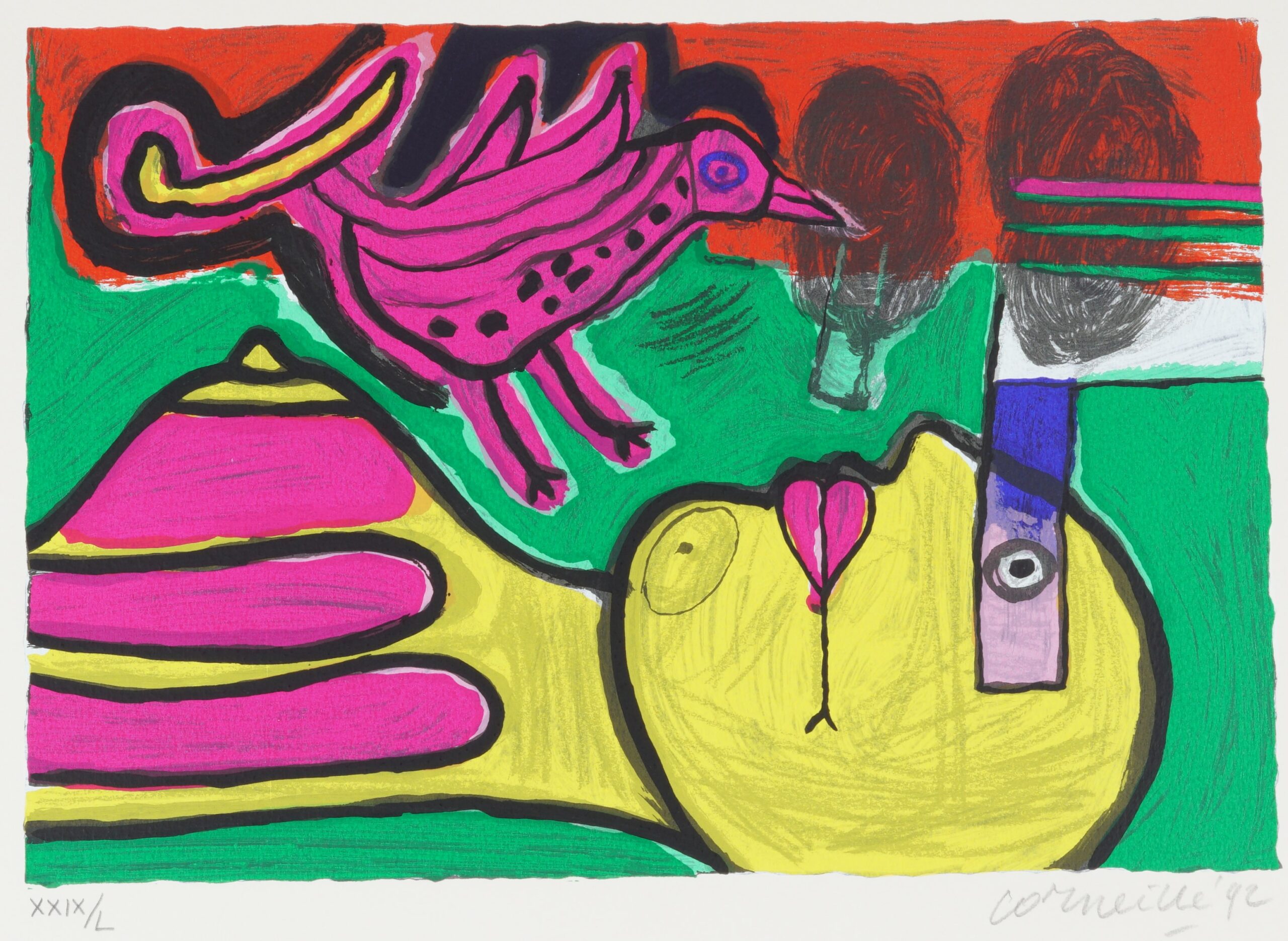
Corneille, born Guillaume Cornelis van Beverloo (Liège, 1922 – Auvers-sur-Oise, 2010), is one of the founders of the post-war avant-garde. Born to Dutch parents, he took drawing and etching classes at the Amsterdam academy and was otherwise self-taught; his earliest inspirations were Picasso, Miró and Doucet.
In 1948 he co-founded CoBrA together with Karel Appel and Constant, the acronym of Copenhagen, Brussels and Amsterdam. The movement turned away from academic rules in search of spontaneity, freedom and the direct imagination of children's drawings and folk art.
Corneille's visual world is instantly recognisable: birds, women, the sun and a lush nature, captured in rounded forms and bright, unmixed colour. Where Appel paints raw and physical, Corneille sounds lyrical, like a poet with paint celebrating the earth and its fertility.
After moving to Paris in 1950 he travelled extensively through North Africa and America. Those journeys brought light, warmth and ornament into his work; his figures grew more mythical and his palette more sunlit. For Corneille, colour became the protagonist.
Corneille was also an exceptionally prolific printmaker. It was precisely his lithographs and screen prints that made his colourful universe widely accessible: recognisable, warm and immediately felt. That is why his work remains so beloved among collectors, and why it holds a permanent place at Delft Gallery.