
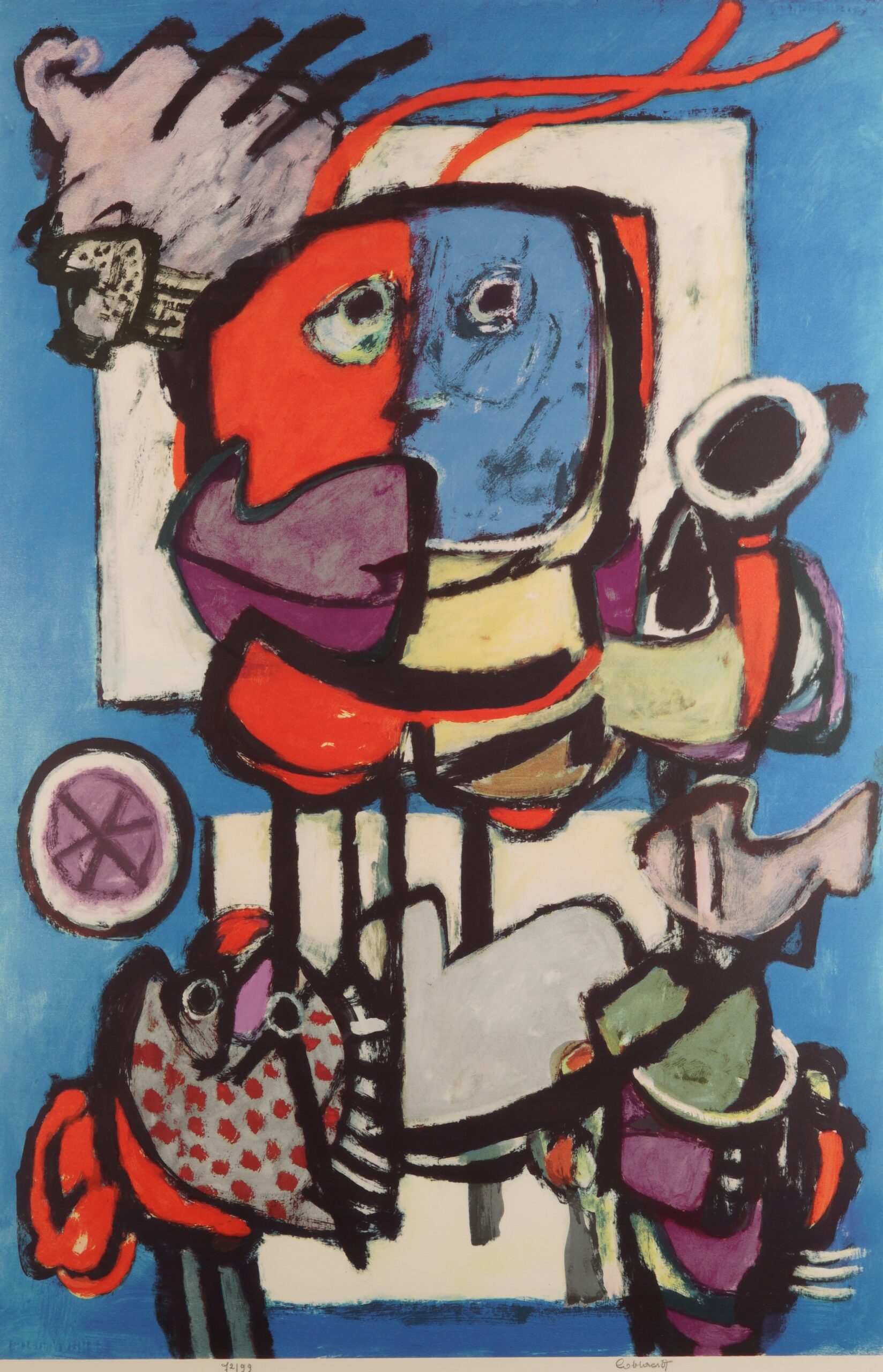
CoBrA was founded on 8 November 1948 in Paris. The name is a contraction of the three cities the core members came from: Copenhagen, Brussels and Amsterdam. Its founders included the Dane Asger Jorn, the Belgians Christian Dotremont and Joseph Noiret, and the Dutchmen Karel Appel, Constant and Corneille.
The movement was a reaction against the rigid, rational art of the years before and during the war. The CoBrA artists sought spontaneity, freedom and experiment. They found their inspiration in children's drawings, folk art, mythology and the unconscious: everything that was unaffected and direct.
This translated into a recognisable visual language: bright, unmixed colours, powerful black contours and fantastical creatures, birds, suns, masks and figures. The touch is energetic and seemingly impulsive, but the directness is deliberate: a childlike freedom with the hand of a master.
As a formal movement CoBrA was short-lived; the group had already broken up by 1951. Yet its influence was enormous. Several members, with Appel and Corneille at the forefront, grew into internationally celebrated artists whose work today hangs in the most important museums and collections.
It is precisely that combination of immediate joie de vivre and raw power that makes CoBrA work still so appealing. It is instantly relatable, and at the same time of lasting museum value. The collection of Delft Gallery is to a significant extent built around these masters and their circle.