
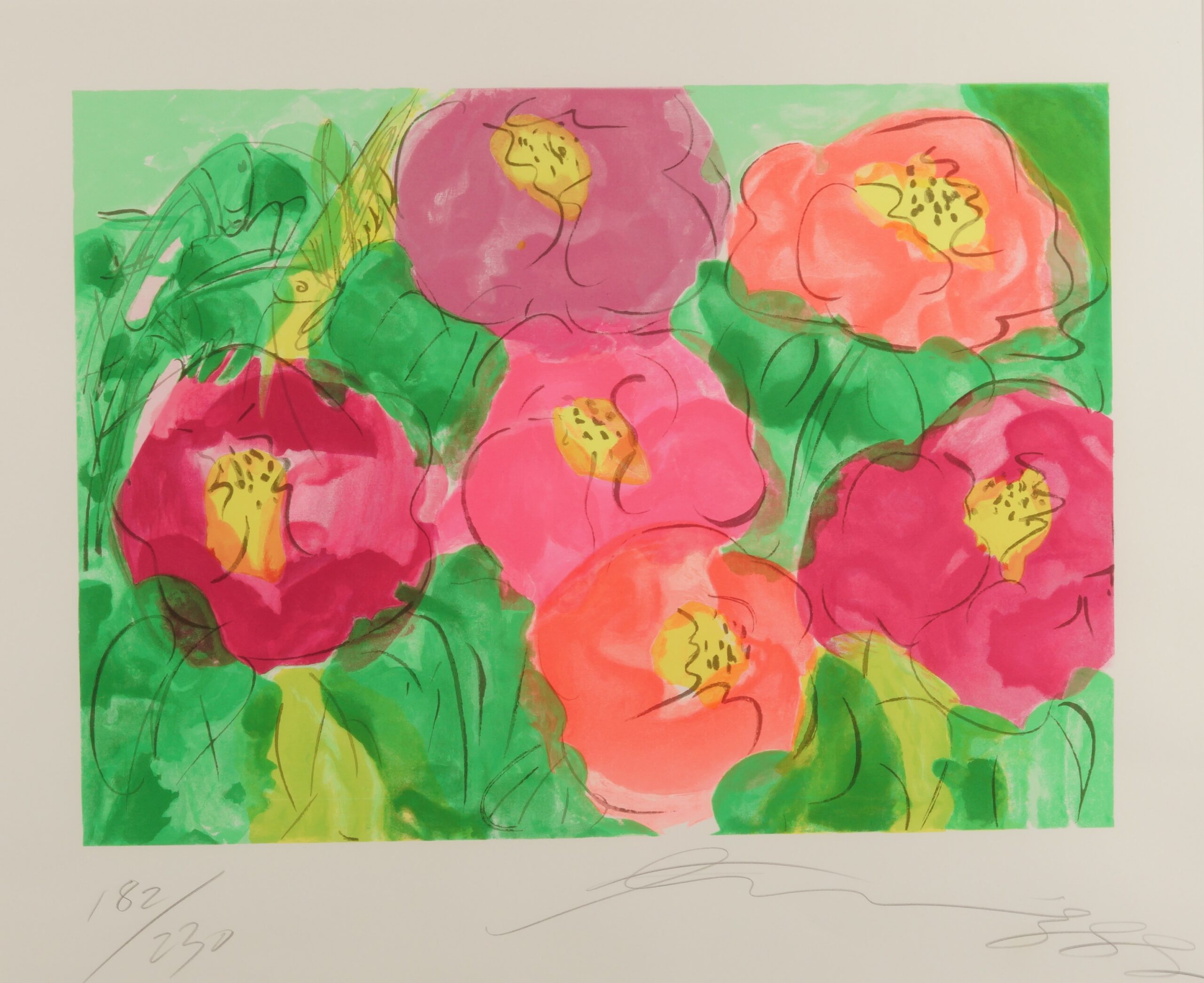
Few artists carry as many worlds within them as Walasse Ting. He was born in Wuxi in 1929 and grew up in Shanghai, where Chinese painting was second nature to him from an early age. In 1946 he left China. By way of Hong Kong he arrived in Paris in 1952, and there everything changed.
In Paris he became friends with Pierre Alechinsky and Karel Appel, artists who had no time for rules. Ting felt at home at once. In 1960 he crossed the ocean to New York, yet Europe stayed close. In Amsterdam he shared a studio with Appel and Corneille, old friends who recognised his free way of working.
Only in the 1970s did everything come together in the style he is now known for. Ting used the calligraphic brushstroke of his youth as a contour and filled those shapes with acrylic in colours that almost leap off the canvas. Women, flowers, birds and cats keep returning, always with an infectious vitality.
What is remarkable is that Ting never attended an academy. He was self-taught, and perhaps that is exactly why he was so free. Even so, his work now hangs in the Stedelijk Museum in Amsterdam, the Art Institute of Chicago, the Centre Pompidou and the Guggenheim. Few self-taught painters end up in that company.
Standing in front of a Ting, you feel that double origin straight away. The calm and rhythm of Chinese brushwork, and over it the exuberant colour of the West. It is that combination that makes his paintings so direct and so easy to love.
At Delft Gallery, Walasse Ting is represented with work in which that colour and vitality are fully present. These are pieces that make a room breathe.